Once you've got your camera set up, the next challenge is to choose your shots. The official NHL togs are able to capture moments of explosive action from any angle in the rink, thanks to banks of remotely-triggered cameras in positions that you and I could never get to. That doesn't mean I can't get good shots, though.
Vantage point is very important, and what you can achieve will depend on what the rink allows. I find the most effective shots come from next to the glass. Don't worry about smudges and smears (generally) on the glass - your f/2.8 (or similar) aperture will shoot through them with barely a mark on your image.
I find that the most effective shots tend to fall into distinct categories - for my own purposes, I call these "explosive action", "on the puck" and "players". I always try to capture the puck in shot.
"Explosive Action" are moments that show intense activity in the game - like the shot above. You can see the failed attempt to take the puck away from the forward, and you can see that he's really struggling to stay on his skates as he drives forward hard. Players crashing into each other also make good "explosive action" shots, but so do shots even as simple as one player turning hard on the ice, frequently sending up a cloud of fine ice spray behind them. "Explosive Action" shots are always the most difficult to achieve with great accuracy, and it will take plenty of practice to capture the "decisive moment" when everything comes together. Don't be afraid to spray & pray with your shots when the action comes close to you, and don't check your shots until there's a break in the game - I've lost count of the number of times I've lost perfectly good shots because I've been reviewing my images instead of watching the action.
"On the Puck" shots are those that show players in the normal course of the game - perhaps like a standard press shot - where the player is skating with the puck. I try to keep these shots as interesting as possible and sharp - I'm far less forgiving than I am with "explosive action" shots.
"Players" shots are not necessarily on the puck at all. I reserve these for close-up shots of the players themselves. Framing is all-important, and I find it crucial to have the player almost full-face onto the camera..
In terms of framing, always try to get as much of the action as large in the frame as possible. Unless you're using a 400mm or 600mm lens - which means you're probably a pro - you'll end up cropping the finished result to achieve this. 200mm or less will end up with too much junk in the image, and most British rinks look pretty poor and shabby.
Next time, I'll have a look at the post-processing steps I usually go through to get my finished images.
Saturday, 16 October 2010


Wednesday, 13 October 2010
Ice Hockey
Ice Hockey is one of my favourite sports, and the season in the UK runs from September - April. I used to be able to get to see Elite League matches regularly (albeit I could never get a good enough vantage point to take photographs), but since the drop of Basingstoke Bison into the English Premier League, I have contented myself by being a regular visitor to the Guildford Flames.
Ice Hockey is a tricky sport to photograph. A quick trip to the galleries hosted over on NHL.com show stunningly clear images, shot by the best photographers in the business, with access to press boxes and team benches that amateurs like me could never hope for. Unless you're armed with a D3 and have negotiated a special vantage point, you're going to have to "cheat" your shots.
The first problem in Ice Hockey is the light; without exception, games are played indoors in artificial lights. The crowd are usually kept in semi-darkness to enhance the brightness of the rink. Secondly, there is a great big white rink in the way, throwing your exposure settings and white balance into chaos. This gets even more fun when you consider that many teams play in largely-white kits as well. Combine this with a necessarily-fast shutter speed, telephoto lenses and a requirement to hand-hold the camera, you have all the ingredients for a sports photography nightmare.
I tend to use these settings for my shots, which I find time and again give me reliable output - they may not always be perfect, but they work more often than they fail, leaving me with the important business of seeing the action and grabbing the shot.
Camera Mode: Aperture Priority. You don't need to be fiddling with manual settings while working at high speed.
Aperture: f/2.8. Anything more and you'll lose the shutter speed you need.
Shutter: 1/500. You can get away with slightly slower, but hockey is a fast moving game. 1/200 will frequently give you blurred pictures.
ISO: 1600.
WB: Auto. I have never found a WB setting that accurately captures the colours of an ice hockey rink, but I find that a colour temperature of somewhere around 4800 - 5100 generally works well.
You will have to adjust your vantage point depending on the rink you go to. I find that the best views can be obtained by standing up to the glass at the corners of the rink - usually a handful of supporters are allowed into these positions, so you have to arrive early and be prepared to stand for a long time in order not to lose your place. It doesn't generally matter which end you stand at, as there will usually be a fair share of action all over the rink. As a solo photographer, you won't be able to "chase" the action all over the arena, so don't try.
Later, I will discuss shooting tips and then move onto post-processing.
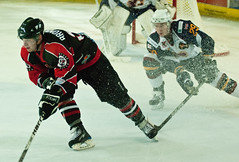
Ice Hockey is a tricky sport to photograph. A quick trip to the galleries hosted over on NHL.com show stunningly clear images, shot by the best photographers in the business, with access to press boxes and team benches that amateurs like me could never hope for. Unless you're armed with a D3 and have negotiated a special vantage point, you're going to have to "cheat" your shots.
The first problem in Ice Hockey is the light; without exception, games are played indoors in artificial lights. The crowd are usually kept in semi-darkness to enhance the brightness of the rink. Secondly, there is a great big white rink in the way, throwing your exposure settings and white balance into chaos. This gets even more fun when you consider that many teams play in largely-white kits as well. Combine this with a necessarily-fast shutter speed, telephoto lenses and a requirement to hand-hold the camera, you have all the ingredients for a sports photography nightmare.
I tend to use these settings for my shots, which I find time and again give me reliable output - they may not always be perfect, but they work more often than they fail, leaving me with the important business of seeing the action and grabbing the shot.
Camera Mode: Aperture Priority. You don't need to be fiddling with manual settings while working at high speed.
Aperture: f/2.8. Anything more and you'll lose the shutter speed you need.
Shutter: 1/500. You can get away with slightly slower, but hockey is a fast moving game. 1/200 will frequently give you blurred pictures.
ISO: 1600.
WB: Auto. I have never found a WB setting that accurately captures the colours of an ice hockey rink, but I find that a colour temperature of somewhere around 4800 - 5100 generally works well.
You will have to adjust your vantage point depending on the rink you go to. I find that the best views can be obtained by standing up to the glass at the corners of the rink - usually a handful of supporters are allowed into these positions, so you have to arrive early and be prepared to stand for a long time in order not to lose your place. It doesn't generally matter which end you stand at, as there will usually be a fair share of action all over the rink. As a solo photographer, you won't be able to "chase" the action all over the arena, so don't try.
Later, I will discuss shooting tips and then move onto post-processing.
Saturday, 9 October 2010
Too Much Sport
Having gone from a fairly quiet summer of sport, I now find that I'm totally overloaded with a crowded football and hockey fixture list. I've got a huge backlog of photos to upload, and tonight I'm off to yet another event down in Guildford. I believe the phrase is "workflow management" but right now I'm suffering from a classic problem - too many photos, not enough time!
Thursday, 7 October 2010
Antonio Goya
Every so often, I stumble across some amazing images on Flickr. One photographer who has really caught my eye of late is Antonio Goya. His portraits, shot with nothing more than a Nikon D90 and a 50mm lens, are a true lesson in stunning photographic work. They knock my efforts into a cocked hat.
Goya shoots what I would call "everyday" portraits - images of normal people, in normal poses. They are timeless, expressive images, and most are simply a joy to look at. Do check out his body of work - if he isn't already a professional tog, then I'm sure he soon will be.

Goya shoots what I would call "everyday" portraits - images of normal people, in normal poses. They are timeless, expressive images, and most are simply a joy to look at. Do check out his body of work - if he isn't already a professional tog, then I'm sure he soon will be.
Tuesday, 28 September 2010
Boring Photographs
As well as highlighting some of what I consider the best of photography, every so often I think it's good to have a look at some of the worst. I have no axe to grind with Gary Shield - by the looks of things, he's a regular tourist snapper who takes shots to remind himself of where he's been - which is all absolutely fine.
But I do have to wonder, what the hell is this a shot of? It's a broken caravan, half hidden out of shot by a tree. Why is this photo even taken? Who wants to look at it? Who would want to be reminded of this, except for an insurance claim for a holiday gone badly wrong?
Ironically, the image has around 270 views, numerous favourites and several comments - more than any single image of mine that I've ever taken (apart from one where some AFC Wimbledon fans started debating over which of their number was wearing a wedding dress in the crowd). It is also one of the first images that appears when you type "Chertsey" into the Flickr search.
Sour grapes? You bet!

But I do have to wonder, what the hell is this a shot of? It's a broken caravan, half hidden out of shot by a tree. Why is this photo even taken? Who wants to look at it? Who would want to be reminded of this, except for an insurance claim for a holiday gone badly wrong?
Ironically, the image has around 270 views, numerous favourites and several comments - more than any single image of mine that I've ever taken (apart from one where some AFC Wimbledon fans started debating over which of their number was wearing a wedding dress in the crowd). It is also one of the first images that appears when you type "Chertsey" into the Flickr search.
Sour grapes? You bet!
Saturday, 25 September 2010
Penton Hook Lock
Despite the chilly conditions, I spent this morning wandering over Penton Hook Lock, an island on the edge of the river Thames at its western end.
Photo opportunities were quite limited, but I tried to make the most of the scenery. This was my favourite shot of the day - I quite like the way that the river winds round and leads the eye into the boat moored in the centre. It's a bit of a postcard shot, but not everything has to be arty, does it?
I dithered this week over buying a second-hand Nikon D3 - but then went against it. I can't afford it at the moment, with a wedding to pay for. This morning, though, it was an absolute pleasure to just grab my trusty D80, go out & play. Not everything needs expensive kit!
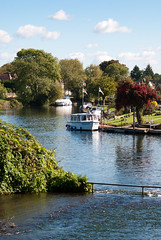
Photo opportunities were quite limited, but I tried to make the most of the scenery. This was my favourite shot of the day - I quite like the way that the river winds round and leads the eye into the boat moored in the centre. It's a bit of a postcard shot, but not everything has to be arty, does it?
I dithered this week over buying a second-hand Nikon D3 - but then went against it. I can't afford it at the moment, with a wedding to pay for. This morning, though, it was an absolute pleasure to just grab my trusty D80, go out & play. Not everything needs expensive kit!
Tuesday, 21 September 2010
Brian Duffy
Brian Duffy was one of the major photographers of the 1960's and 1970's, and is the subject of discussion - briefly - in this week's Amateur Photographer magazine. Duffy famously burnt most of his negatives in 1979 during a breakdown, destroying some of the most famous fashion and biography images ever taken. However, much of his work has been restored and some of his most famous images are on display until 19th November at the Lucy Bell Gallery in St Leonard's On Sea, near Hastings in East Sussex.
Aspiring fashion or personality photographers should take note of Duffy's work; he was at the forefront of his craft at the height of the swinging sixties. In many ways, Duffy shaped the work of "celebrity" photographers for the years to come. His style is very clean - plain white backgrounds, simple objects - and relaxed poses, often with the sitter caught mid-way through doing or saying something.
Duffy passed away this year, and this is the first major exhibition of his work since his death. Admission is free.
Subscribe to:
Posts (Atom)


